
Sex Offender Checks in Gloucester County
The New Jersey Sex Offender Internet Registry is the first official source for a Gloucester County sex offender check. The New Jersey State Police and State Bureau of Identification manage the statewide internet publication. All county prosecutor offices submit records for state review. At the local level, a person registers with the chief law enforcement officer in the municipality of residence, or with NJSP where no local police department exists. The Gloucester County Prosecutor assesses risk and the scope of notice, subject to judicial review.
That chain explains why there is no separate Gloucester County public roster to replace the state registry. Washington Township, Monroe Township, Deptford Township, and other local police departments collect registration information. The Prosecutor and courts address tier and notice questions, while NJSP publishes the part approved for internet access. Start with a full name or a specific place. Keep alternate spellings and known aliases close at hand. Search results support awareness, but only the official profile and the responsible agency can supply the current public record.
Missing Gloucester Registry Results
A blank Gloucester County registry result does not prove that no one is registered. Tier One registrants are not placed on the public internet registry. Some Tier Two records also remain outside public internet publication because New Jersey links disclosure to risk, notification rules, statutory exceptions, and court review. A record may also be hard to match because of a name variant, alias, location change, or the limits of the search route.
Registration and publication are separate acts. Local police may hold a valid registration even when the person does not appear online. Gloucester County's public Megan's Law material also says officials will not confirm a named person's registration status to a caller. Report a good-faith concern about nonregistration to local police or the Gloucester County Prosecutor instead of treating a public search as a demand for confidential confirmation.
How to Search the New Jersey Sex Offender Internet Registry
Use the NJSP registry for the state's authoritative public publication. The live interface may use access controls, and the research inspection could not safely verify every current radius or dropdown option. Do not assume an unverified filter exists. For a search that crosses state lines, use the official federal NSOPW tool after checking New Jersey. The two systems answer related but distinct questions.
- Open the NJSP internet registry, read its conditions, and begin with the person's name or the supported geographic route.
- Try a known alias or place when the first Gloucester County sex offender search does not identify a clear match.
- Compare the result's photograph, physical traits, address, offense, and conviction information before drawing a conclusion.
- Use local police or the Gloucester County Prosecutor to report a possible registration violation. Call 911 only for an immediate danger.
The table separates search controls that official sources support from those that were confirmed in the inspected NSOPW interface.
| Search field | Tool | Required | Use |
|---|---|---|---|
| Name or geographic lookup | NJSP registry | Route dependent | Official materials support these routes, but exact current controls require live verification. |
| First and last name | NSOPW | Both for name route | Searches participating public registries and permits optional place filters. |
| County and city/town | NSOPW | No | Narrows a name search toward Gloucester County communities. |
| ZIP codes | NSOPW | Alternative route | Accepts up to five ZIP codes separated by spaces. |
| Address and distance | NSOPW | Yes for radius route | Requires an address, city, state, and distance where coordinate data is available. |
Note: Exact NJSP filters can change, so use only controls shown by the live official registry rather than relying on old search instructions.
Gloucester Registry Search Across Borders
The National Sex Offender Public Website adds a cross-jurisdiction layer. It can search by first and last name, up to five ZIP codes, or an address radius. It also permits state, territory, and participating Indian Country filters. Results may show an offender name, age, aliases, and address, then route the reader to the jurisdiction that owns the source record.
This official NSOPW search view shows why the national interface helps when a concern reaches beyond Gloucester County.
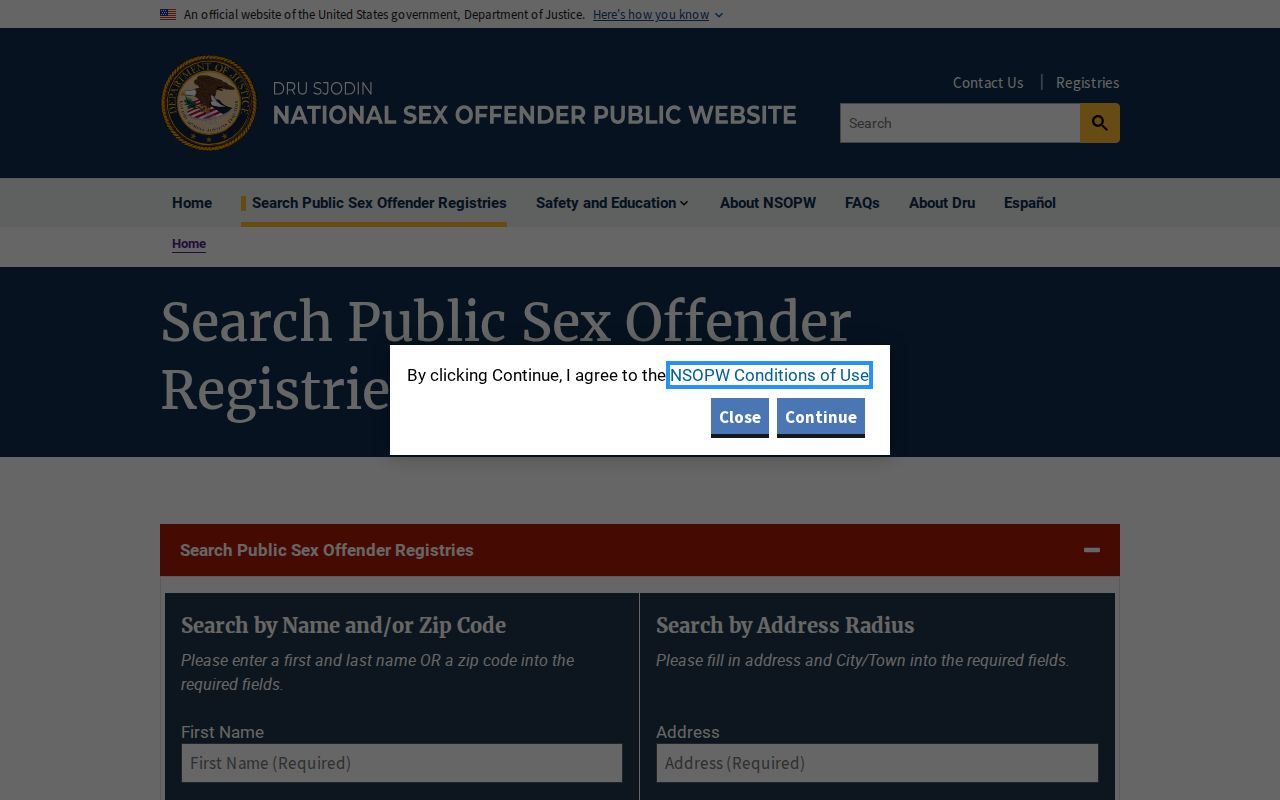
The search controls support broad awareness, but the state or tribal registry remains the source to verify a returned record.
Radius results have limits. A jurisdiction that does not supply coordinate data may fall back to a ZIP search, which covers a wider area than a precise circle. A missed radius hit therefore cannot prove that the area has no publicly listed registrant. Search the NJSP registry as the authoritative New Jersey layer, then read the linked jurisdiction profile before acting on an NSOPW result.
Inside a Registry Profile
A public registry profile brings identity, location, and case facts together. The Attorney General's guidance supports the field classes below. A live privacy-neutral Gloucester County profile was not opened during research, so unverified labels such as scars, tattoos, extra affiliations, or a specific compliance badge are not presented as standard fields.
| Name and aliases | The published identity and alternate names used to match the person. |
|---|---|
| Age and birth details | Age or date-of-birth information available under the public profile rules. |
| Physical description | Sex, race, height, weight, hair color, eye color, and photograph. |
| Registered address | The address approved for public notification under the person's tier and court order. |
| Offense facts | Offense description, conviction or adjudication date, place of offense, and sentence. |
| Vehicle details | Vehicle identifiers included under New Jersey public notification guidance. |
Read each field as part of one official record. A similar name alone is weak evidence. Compare the image, physical description, alias, and location. Offense and sentence details explain the underlying judgment, while the tier controls notification. Public profiles do not authorize assumptions about current conduct.
Gloucester Megan's Law Review
The Gloucester County Prosecutor does more than forward a local registration. The office assesses the risk of reoffense and the proper level of notification, and that assessment is subject to judicial review. The tier reflects risk and public-notice scope. It is not a simple measure of how serious the offense sounds, nor is it the federal ten-year, twenty-five-year, or lifetime structure sometimes seen in other systems.
The Gloucester County Megan's Law FAQ explains local registration, qualifying offenses, internet visibility, and petitions for relief.
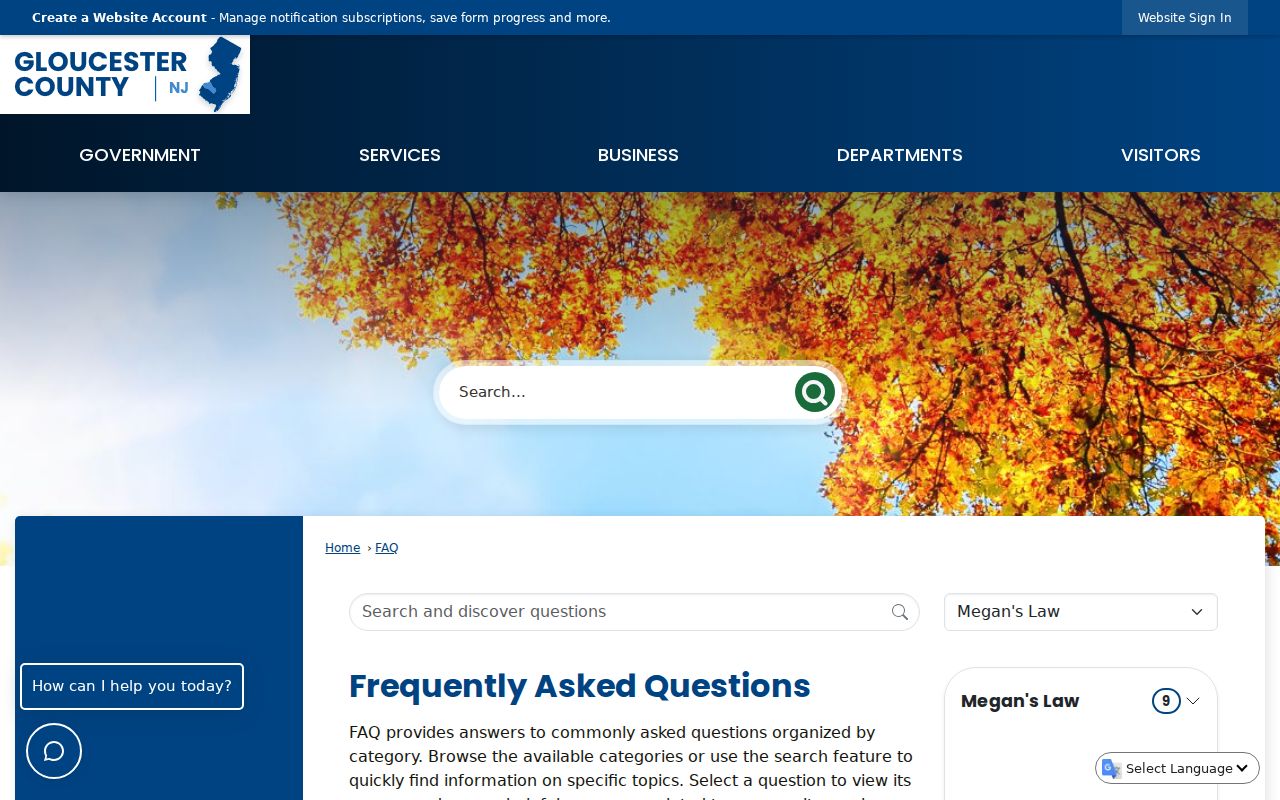
The county explanation helps connect a local police registration to prosecutor review, court oversight, and the statewide public registry.
New Jersey Registration Levels and Requirements
New Jersey's three tiers define risk and notification. They do not create a fixed tier-by-tier duration table. Gloucester County's FAQ says a person with one offense may petition after fifteen offense-free years and must prove that they are not likely to pose a threat. Aggravated sexual assault, sexual assault, and repeat-offender cases cannot use that general route. A qualifying juvenile whose act occurred before age fourteen may petition at age eighteen under a separate clear-and-convincing standard.
| Tier | Risk meaning | Notification and visibility |
|---|---|---|
| Tier One | Relatively low risk | Notice goes to law enforcement likely to encounter the person; no public internet listing. |
| Tier Two | Moderate risk | Notice can reach law enforcement, schools, child-care providers, camps, and qualifying groups; some records appear online. |
| Tier Three | High risk | Broad public notification applies, and all Tier Three registrants appear online. |
Address changes must be reported, and people who move into New Jersey may have a duty to register. The 2024 changes also address certain out-of-state workers, vocations, and postsecondary affiliations. Verification duties depend on the law and the person's order, so no unsupported county schedule should be inferred from the public tier table.
Gloucester Registry Petition Limits
The fifteen-year language is a petition threshold, not an automatic expiration date. An eligible person must have a single offense, remain offense-free for the stated period, and prove no likely threat. The court decides the petition. Some offense categories and repeat offenses are excluded from the general provision. Juvenile relief follows its own age and proof rules.
For a Gloucester County record search, this distinction matters because a profile can remain valid beyond a date someone expected it to disappear. The opposite can also be true: removal after a lawful order is not proof that the registry lost a record. Current court orders and agency records control. The enacted New Jersey registration law is the best source for current statutory changes.
The official 2024 act documents recent changes to New Jersey's registration framework.
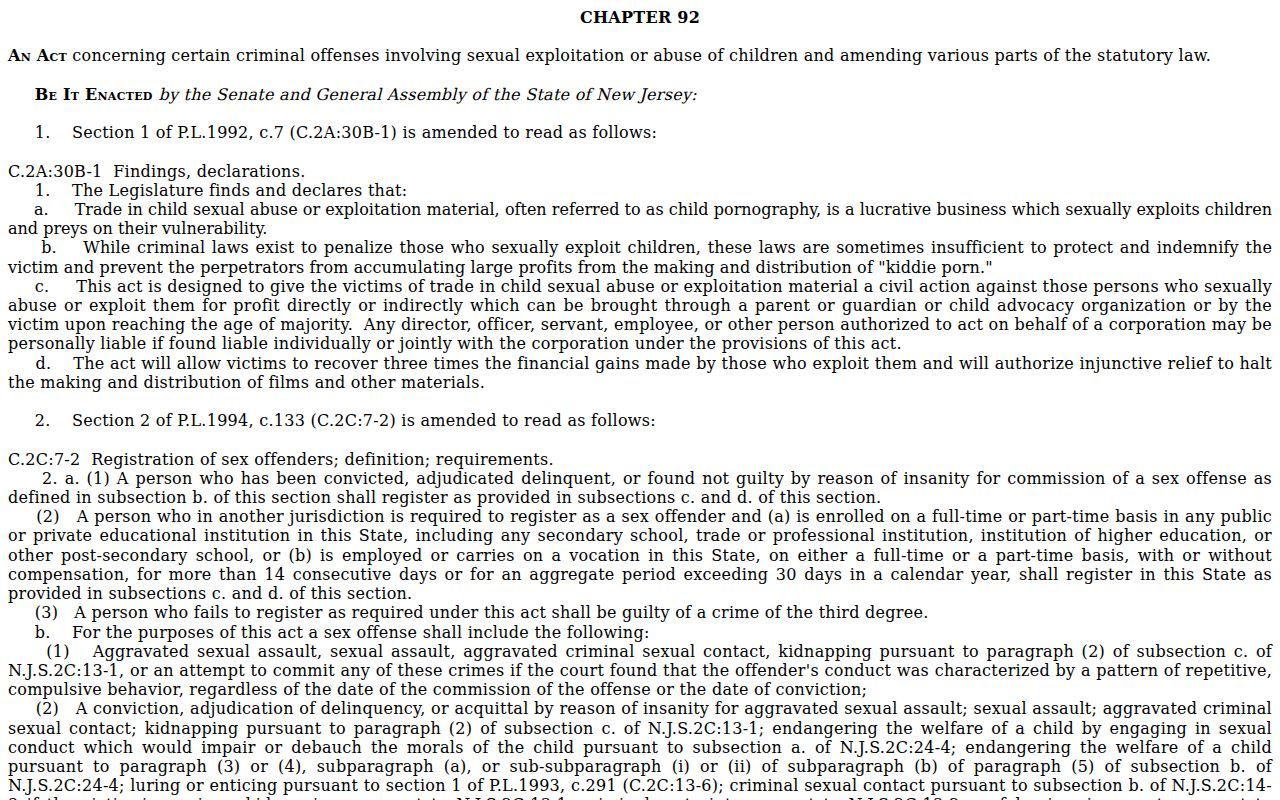
The enacted text, rather than an introduced bill or a summary from a private site, should guide any date-sensitive conclusion.
Gloucester Local Police Registration
Registration takes place with the chief law enforcement officer in the municipality where the person lives. In Gloucester County's largest townships, that means the local police department. The process collects identifying and location data, including the home address, and it requires notice of address changes. The local record then moves through county risk review and the state system according to New Jersey law.
Suspected failure to register is reported to the local police department or the Gloucester County Prosecutor. Frame the report as a concern and provide the facts known, such as the location and the reason for concern. Officials may investigate, but Gloucester County's published FAQ says they may not confirm a named person's registration status to a caller. An urgent safety threat belongs with 911.
Gloucester Tier Two Visibility
Tier Two is the point where a broad statement such as "all registrants are online" breaks down. Moderate-risk notice reaches law enforcement and defined community organizations, while internet publication depends on New Jersey's governing rules and any applicable exception. That is why two people with registration duties can have different public visibility.
A Gloucester County searcher should not try to fill the gap with a commercial people-search service. Those sources cannot override an official publication rule or establish current compliance. Use the NJSP registry, the official NSOPW layer when needed, and the appropriate law enforcement reporting route. For wider county criminal-record context, the Gloucester County criminal history overview explains why police, court, custody, and state records answer different questions.
Community Notification and Lawful Use
Community notification exists for public safety awareness. It can help a household understand an official notice, check a neighborhood, or plan a calm response to a verified profile. The result is not permission to confront anyone, spread unsupported claims, or organize vigilantism. Verify the official profile and use law enforcement for a suspected violation.
Misuse is a crime: N.J.S.A. 2C:7-14 warns against threats, intimidation, harassment, and other misuse. Under N.J.S.A. 2C:7-16(b), using registry information to commit a crime adds a third-degree crime, while using it to commit a disorderly or petty disorderly offense adds a disorderly-persons offense.
Keep the response tied to safety. Save the official record, note the source and date, and report a concrete concern to the police agency that can act on it. Public registry information can be incomplete, limited by law, or changed after review, so a fresh official check is better than a saved screenshot when the facts matter.